
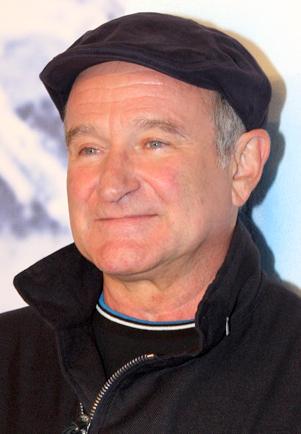
Robin Williams was a great comedian and person.
Robin Williams: The Man Who Could Be Anyone — And Broke Our Hearts Being Himself
A profile of the most gifted comedic mind of the 20th century
The Why Now
More than a decade after his death, Robin Williams remains one of the most talked-about, most mourned, and most studied entertainers who ever lived. His films are still watched daily across the world. His stand-up specials still make people laugh until they cry. And the circumstances of his death — and what drove him to it — have sparked lasting global conversations about mental health, invisible suffering, and the hidden costs of making others happy.
According to Judd Apatow, Williams' rapid-fire improvisational style was an inspiration as well as an influence for other comedians — but his talent was so extremely unusual, no one else could possibly attempt to copy it. Wikipedia That is the truest measure of a one-of-a-kind talent: not that others try to be like them, but that they understand it's simply not possible.
Origins: A Quiet Boy in a Loud Mind
Robin McLaurin Williams was born on July 21, 1951, in Chicago, Illinois. He was born to Robert Fitzgerald Williams, a Ford Motor Company executive, and Laurie McLaurin, a former model. Williams grew up in comfort, attending private schools and living in affluent neighborhoods. Confinity
The public image of Williams — explosive, relentless, all-consuming — bears almost no resemblance to the child he was. Williams was not an outgoing child in his childhood; he was quite the opposite, spending most of his time in his own thoughts, which often made him feel lonely. His family moved frequently, and he realized his love for performing arts during this solitary period. Confinity Comedy was not something he was born performing — it was something he discovered as a way to connect, to survive, and eventually, to soar.
He studied political science at Claremont Men's College before enrolling at the College of Marin to study acting. He later received a scholarship to study at the Juilliard School in New York City, where he was mentored by John Houseman. Encyclopedia Britannica It was at Juilliard that he first encountered his comedy idol Jonathan Winters, the wildly improvisational television comedian who, Williams later said, "made it possible to do voices, character, sound effects and all these different things that just opened the world up. He was morphing before the technology." PBS
The Stand-Up Stage: Where the Lightning First Struck
Williams began his career as a stand-up comedian in San Francisco, learning the art of improvisation and applying the innovative new technique to his stage performance. Audiences loved his fresh and energetic persona. PBS He then moved to Los Angeles, where he performed at clubs including the Comedy Store and the Roxy, relentlessly sharpening a style that operated on a frequency no one else could tune into.
His stand-up was unlike anything the comedy world had seen. Where other comedians delivered jokes, Williams delivered weather systems — rapid, unpredictable, pulling in voices, characters, accents, observations, and physical transformations at a speed that left audiences simultaneously laughing and slightly disoriented. You never knew what was coming next. Neither, often, did he.
In 1977, he was seen by television producer George Schlatter, who asked him to appear on a revival of his show Laugh-In. New World Encyclopedia The doors of television began to open.
Mork & Mindy: The Alien Who Conquered Earth
Williams was cast as the alien Mork in a 1978 episode of the TV series Happy Days. Sought after as a last-minute cast replacement, Williams impressed the producer with his quirky sense of humor when — asked to take a seat for his audition — he sat on his head. New World Encyclopedia That was not a bit. That was Robin Williams being Robin Williams, and it was enough.
Mork & Mindy (1978–1982) proved an immense success and was instrumental in launching Williams's film career, offering him the opportunity to transfer the enthusiasm of his stand-up performances to the small screen and providing an outlet for his prolific improvisational talents. Encyclopedia Britannica He improvised much of his own dialogue. The writers eventually learned to simply leave blank space in the script and let him fill it.
The Films: A Career of Radical Range
What followed was one of the most astonishing filmographies in Hollywood history — not simply because of the number of hits, but because of the sheer breadth of emotional and tonal territory covered.
The comedian: Aladdin (1992), in which he improvised 52 different characters, was the highest-grossing film of the year. Wikipedia Mrs. Doubtfire (1993), Jumanji (1995), and The Birdcage (1996) cemented his status as the most bankable comedic actor in Hollywood.
The dramatic actor: Good Morning, Vietnam (1987) earned Williams his first Academy Award nomination for Best Actor. Dead Poets Society (1989), Awakenings (1990), and The Fisher King (1991) generated further nominations. New World Encyclopedia These were not comedians doing drama. These were performances of profound emotional depth from an actor who happened to also be the funniest person alive.
The Oscar moment: In Good Will Hunting (1997), he played a psychiatrist who mentors a troubled but mathematically gifted young man. The performance earned him the Academy Award for Best Supporting Actor. Encyclopedia Britannica In his acceptance speech, Williams was — for once — briefly quiet, visibly moved. It was one of the few moments the world saw the stillness inside the storm.
The villain: In One Hour Photo (2002) and Insomnia (2002), Williams deliberately and successfully dismantled his own likability, playing deeply unsettling characters. It was a creative statement as much as anything: he was not the warmth. He was the actor.
Screen Actors Guild president Ken Howard described him as "a performer of limitless versatility, equally adept at comedy and drama, whether scripted or improv." Wikipedia
What Made Him Different: The Science of the Gift
Robin Williams didn't perform comedy so much as become it. He was constitutionally incapable of being still on a stage. His mind operated at a pace that seemed to exceed real time — making connections between ideas, characters, accents, and observations faster than audiences could fully track, generating laughter almost as a byproduct of the sheer kinetic energy of his thought.
Director Chris Columbus, who worked with him on Mrs. Doubtfire, said that watching him work "was a magical and special privilege. His performances were unlike anything any of us had ever seen — they came from some spiritual and otherworldly place." Wikipedia
Alyssa Rosenberg at The Washington Post, looking over his filmography, was "struck by the breadth" and radical diversity of his roles, writing that "Williams helped us grow up." Wikipedia
He had a rare quality — the ability to make millions of strangers feel personally seen and personally loved. Children trusted him. Adults broke down watching him. Soldiers stationed in war zones, for whom he performed dozens of times through the USO, cheered for him like he was the sun returning.
Defining Achievements
Williams won an Oscar for Best Supporting Actor, six Golden Globe Awards, five Grammy Awards, two Primetime Emmy Awards, and two Screen Actors Guild Awards. Confinity
His Golden Globe wins included Best Actor in a Musical or Comedy for Good Morning, Vietnam, The Fisher King, and Mrs. Doubtfire, as well as a Special Golden Globe for his voice work as the Genie in Aladdin and the Cecil B. DeMille Award in 2005. Wikipedia
He was hailed "the funniest person alive" by Entertainment Weekly in 1997 — at the very moment he was actively trying to move away from comedy toward more serious dramatic work. The tension between what audiences wanted him to be and what he wanted to become was one of the defining creative struggles of his later career.
The Shadows: Pain Behind the Performance
Robin Williams was, in many ways, a man who gave everything he had to the people around him — and quietly kept very little for himself.
Williams said that, partly due to the stress of performing stand-up, he started using drugs and alcohol early in his career. Wikipedia He struggled with addiction for more than two decades while simultaneously producing some of the most beloved work in American entertainment history. He was candid about his recovery and relapses — a honesty that itself became a form of public service, given how many people were struggling with the same battles in private.
On August 11, 2014, Robin Williams died by suicide at his home in California. He was 63 years old. Just after his death, his wife Susan Schneider disclosed that he had been diagnosed with Parkinson's disease — which he had not revealed publicly. Biography Subsequent autopsy revealed he also had Lewy body dementia — a degenerative brain disease that causes hallucinations, cognitive decline, and severe psychiatric symptoms. Many of those close to him believe the disease had been affecting him for years before diagnosis, profoundly distorting his perception of reality and his capacity to manage his condition.
In her statement, Schneider said: "His greatest legacy, besides his three children, is the joy and happiness he offered to others, particularly to those fighting personal battles." Biography
His death prompted a worldwide outpouring of grief unlike almost anything seen before for an entertainer — not simply mourning a celebrity, but mourning someone who had been a genuine companion to millions through their own hardest moments.
If you or someone you know is struggling, please reach out to the 988 Suicide and Crisis Lifeline by calling or texting 988 (US). You are not alone.
The Legacy
Robin Williams changed what comedy could be and what a comedian could do. He proved that the funniest person in the room could also be the most heartbreaking. That improvisation was not just a technique but a philosophy of human connection. That a man who made everyone laugh could be carrying something the rest of us couldn't see.
Robin Williams is still revered as one of the greatest entertainers ever — due to his brilliance, his inexhaustible energy, and his unending dedication to sharing emotion with people. His comic skills were so flexible that he could move from comedy to drama without any problem, making him an icon adored by audiences across generations. Medium
He is not gone. He is in every comedian who ever took a risk on stage without a safety net. He is in every actor who chose truth over applause. He is in every child who watched Aladdin and felt, for the first time, that someone was speaking directly to their imagination.
Good morning, Vietnam. Good morning, world. O Captain, my Captain.
Sources: Wikipedia, Britannica, PBS Pioneers of Television, Biography.com, The Washington Post, New World Encyclopedia, Screen Actors Guild, HBO Documentary: Come Inside My Mind
Note: This article discusses suicide and mental illness. If you are experiencing a mental health crisis, please contact the 988 Suicide and Crisis Lifeline (call or text 988 in the US) or reach out to a trusted person for support.